October 2025''s meeting was about the construction of the Fehmarn Belt Tunnel between the island of Lolland in Denmark, under the Baltic onto the mainland of Germany.
There is not much known in the UK about this project which is currently the largest construction project in Europe. The cost is estimated to be around €8 billion, but will probably cost more as the project is now expected to be completed well after the original time of 2029. The project will be the world’s longest subsea immersed tunnel.
This image shows one opening to the Fehmarn Belt Tunnel, under construction in May 2025
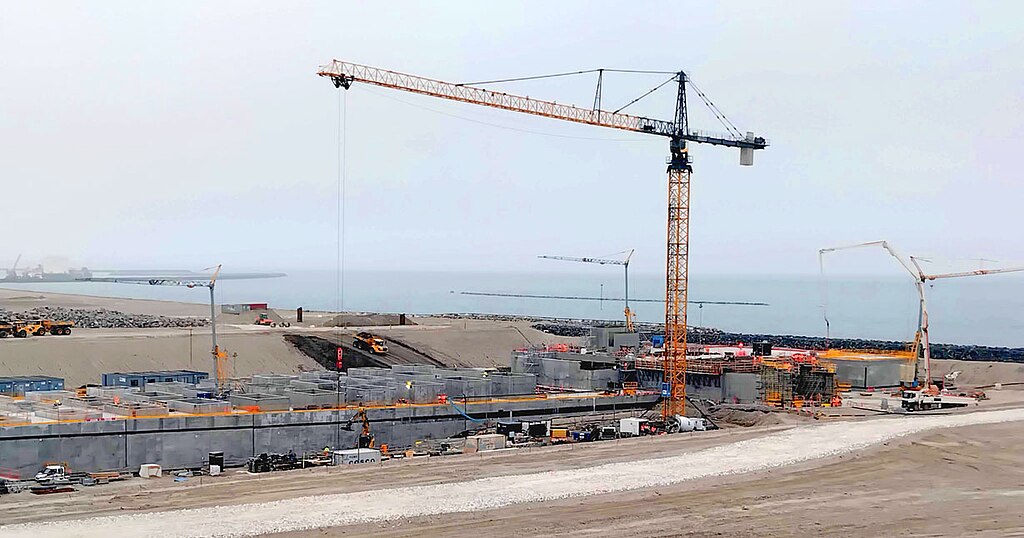
Image source: Wikipedia, Licence

The whole project is designed to link in with the German rail network and autobahns to take traffic through to Copenhagen and on to Sweden via the Oresund Bridge. It is part of the European Union demand for better connectivity. The tunnel is designed to reduce the crossing time of 45 minutes by ferry, down to 7 minutes by train and 10 minutes by car. It will shorten the train journey from Hamburg to Copenhagen from 4.5 hours down to 2.5 hours by elimination of a 110km detour.
This will be sunken tunnel, not bored like the Channel Tunnel, and will be 18kms long consisting of 89 segments of mega sized tunnel elements, each weighing 73,000 tonnes and being 217 metres long, 16 metres wide and 11 metres tall. Each element provides 2 x two lane motorway roads and 2 x rail tunnels, plus a smaller tunnel for access and services. There will be a lower section for workshops and electrical services.
The concrete for each element is poured in a single application into giant moulds. After curing the concrete the units are “wheeled out”, fitted
with end seals ready for floating on pontoons, and shipping out into the Baltic. The units include ballast tanks fitted into the railway tunnels which allow the concrete elements to be sunk in position by filling ballast tanks with water . The system is designed to be positioned to an
accuracy of +/-15 mm, and then through an integral jack system the adjacent units are jacked together and a compressive sealing arrangement activated to ensure the tunnels will remain leakproof. The ballast tanks are emptied when everything is in position.
The tunnel segments sit in a 12m-40m deep trench and are subsequently covered with sand and gravel so that they do not interfere with the marine environment. Also it ensures that there are no shipping hazards in one of the major Baltic sea routes. Whilst the bulk of the channel can be formed by conventional dredging, the deeper sections will have to resort to using special purpose machinery.
A large harbour has had to be constructed to be able to import all the sand, cement, gravel and rebar, required for the project plus the construction of the world's largest factory for manufacturing concrete structures.
To learn more about this fascinating project follow these links...
https://femern.com/the-tunnel/fehmarnbelt-tunnel
https://www.youtube.com/watch?v=jm2ekl2agyM
This is a massive project and will be followed with interested as we monitor its progress through to 2030 and beyond.