When the group gathered on 21 July 2025, they continued to learn how the Impressionist movement spread and had such an immense influence on the arts around the world.
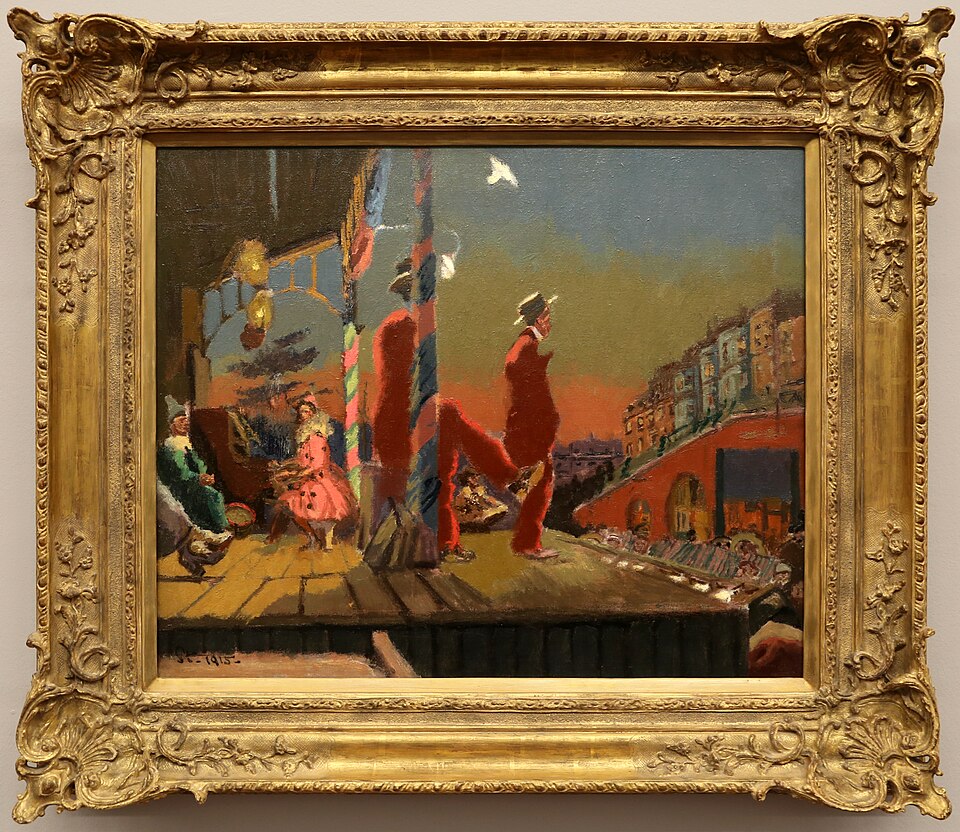
Jenny shared her fascination with ‘Brighton Pierrots’ which was created by the British painter Walter Sickert in 1915. This prompted a stimulating discussion on how the content and colours had been used to create a feeling of forlornness, probably attributed to WWI and the fact that many young men were away fighting.
The artist painted two virtually identical versions of the subject. The first is at the Ashmolean Museum, Oxford and the second (photographed here) is part of the Tate Britain Collection.
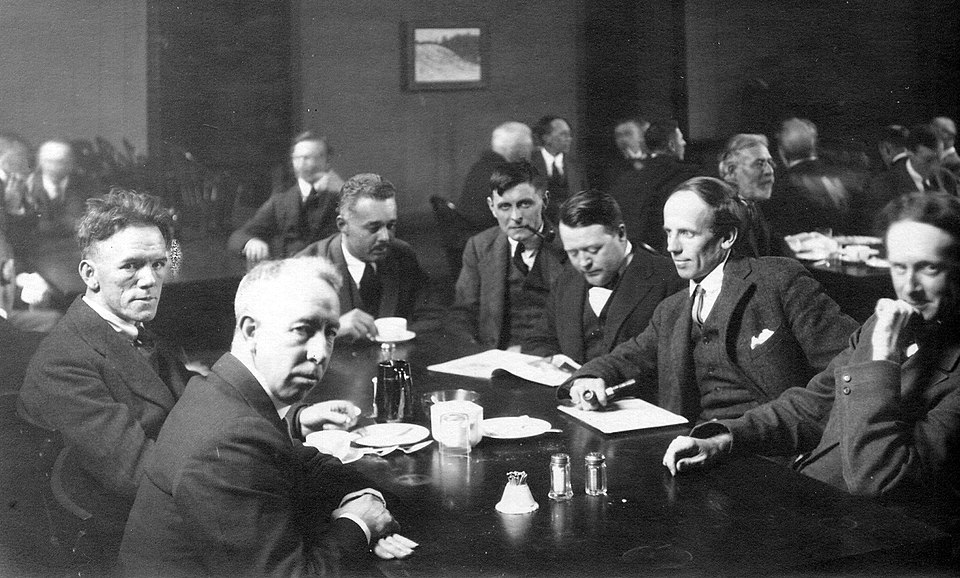


Jill broadened our horizons with photos of her trip to Canada where she had discovered the works of the Canadian Group of Seven (previously called the Algonquin School).
The style of the featured artists was very varied but they all captured that sense of strength and beauty evoked by the mid-Canadian landscape.
This group photo was taken c 1920.
Elizabeth had recently visited Vienna and in particular the Albertina Museum, in Vienna. Whilst there, she had taken the opportunity to photograph several Impressionist and Post Impressionist paintings.
Discussions around six of these, reinforced our knowledge of the Impressionist movement and introduced us to how it had influenced German and Eastern European Art.
Richard wrapped up the session with a short presentation on a local artist, Hector McDonald Sutton, whose work had also been on display at the Mansfield Museum, during the groups visit a couple of weeks earlier. Born in Staffordshire, Hector Sutton was Principal of the former Mansfield College of Art, on Chesterfield Road South, for 31 years until 1968.
After a short break, we formed into groups of two or three to participate in a fun quiz that checked our knowledge of Impressionism. This included learning more about Monet, Manet, Pissaro, Berthe Morisot, Renoir, Degas and Sisley.
Sharan also shared one of her favourite paintings by John Singer Sergeant (1885-1886), entitled ‘Carnation, Lily, Lily, Rose’.
Information of interest shared between group members included:
- The Kiddey Trail launched recently by Newark and Sherwood Council allowed an opportunity to view the power station murals created by local sculptor Paul Kiddey, at the same time as exploring the centre of Newark.
- For anyone interested in learning more about National Trust artworks, there is a BBC series entitled ‘Hidden Treasures of the National Trust’ which is available on I-player