Six members of the group met on Thursday 8 January to discover more about ‘Coins & Medals’.
They firstly looked in depth at the discovery of the famous ‘Fishpool Hoard’ in Ravenshead. On 22 March 1966, the Fishpool Hoard of 1,237 15th century gold coins, four rings and four other pieces of jewellery, and two lengths of gold chain was discovered by workmen on a building site near the present-day Cambourne Gardens.
It is still the largest hoard of medieval coins ever found in Britain. To judge from the dates of the coins, the hoard was probably buried in haste at some time between winter 1463 and summer 1464, perhaps by someone fleeing south after the Battle of Hexham in May 1464, in the first stages of England's civil war between aristocratic factions, the War of the Roses.
The British Museum assessed the face value of the hoard when deposited at about £400, and that would be equivalent to around £300,000 today.
The Fishpool Hoard on display on the British Museum

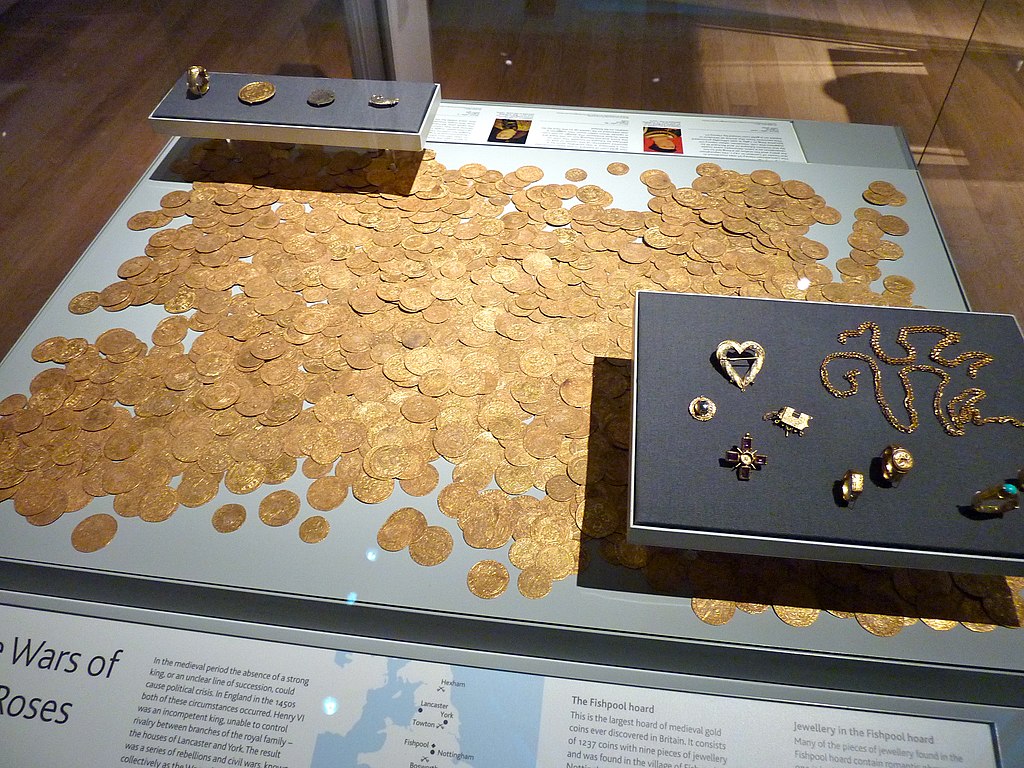
For those involved in the recovery of this spectacular hoard the day would have started much like any other. There were four workmen and a lorry driver on the site. Also present was a small boy, aged five, who lived nearby. One of the workmen was operating an excavating machine. He said coins were first sighted when the mechanical shovel scooped up a group of them. From this account, it is impossible to say if the shovel hit upon the hoard just below the surface, or in a trench. The job in hand must have been forgotten as the four workmen and the lorry driver started to pick up coins and jewellery. The small boy, too, joined in and managed to get hold of four coins. The four workmen were John Craughwell (the excavating machine driver), James Flint, Alfred Martin and Michael Blythe. The lorry driver was Bernard Beeton and the small boy David Welham.
In 1966 the old law of Treasure Trove was in place requiring a formal inquest after such a find. Prior to the inquest, in May of 1966, a man calling himself Hewlitt Cosgrove Thompson walked into a coin dealer’s shop in London with three gold nobles. Thompson said the coins were part of his grandfather’s collection. He returned twice more under the same pretence, and in total the dealer bought coins from him for a total of £23,610. It was only after the coin dealer sold on the 3 tranches of coins in separate transactions to another coin dealer that the second dealer became suspicious, and contacted the British Museum and learned of the finding of the hoard at Fishpool. As a result he handed them over shortly afterwards to the British Museum.
At the inquest, John Craughwell and James Flint both admitted that they tried to hide part of the hoard from the police. In an office on the building site, the day after the discovery, Mr Craughwell handed over some coins and jewellery to a PC Taylor. He told the officer he had found one gold chain, one gold locket, one gold ring and 244 coins. However, only 190 coins were revealed. In August he amended his statement and said he had found 279 coins and kept 35 of them. He later admitted to finding 285 coins. He said he hid some of them behind a skirting board at his home.
The inquest jury decided that the find was Treasure Trove and the property of the Crown. They ruled that only two of the six finders – Bernard Beeton and the boy, David Welham – should be rewarded. The others had concealed some of the items they had found. In doing so their right to a reward was
forfeited.
Hewlitt Cosgrove Thompson was never traced, so his exact identity remains a mystery. However, somehow or other he had access to coins from the Fishpool hoard. Had his identity been established he could have been prosecuted.
The group members then took a refreshment break, which as always included a selection of yummy cakes.

After a review of upcoming Antique Auctions, Antique Fairs and Valuation Days, they then progressed to information about Medal Collecting.
The history of medals in the UK started with the issue of the first one after the Battle of Edge Hill in 1642, which was a round coin without ribbons and more of a recruiting token that was often worn around the neck on a lanyard.
The first Medals that resemble what we see now were awarded to soldiers for the Battle of the Nile in 1797, and for sailors, The Battle of Trafalgar in 1805. It was only in 1847 that Queen Victoria invented the General Service Medal to award to those involved in such battles, some 40-50 years after the action. By then, very few of those who took part were alive to receive their medals.
We were then shown some videos featuring the Medals Expert from the BBC Antiques Roadshow, Mark Smith, talking about medals awarded for battles in the late 19 century, World War 1 and World War 2.