In May 2026 a small group of us heard about the development of the ejector seat.
A brief review of early history told us the first evidence of somebody trying to leave a plane was using a bungy rope in 1910. But it was not until the 1920s when a Romanian engineer, Dragormiri, patented an escape capsule with a parachute.
It was during World War 2 that the shortage of pilots made escaping from un-operable aircraft more important and the Germans were well ahead in this field. We saw a video of some of their early trials using springs and compressed air to eject a seat away from a plane. However a lot of these early trials resulted in the seat hitting the tail of the aircraft and this could cause serious injury to the person ejecting.
They persevered and eventually installed ejector seats on their jet fighter developments. The first ever emergency ejection was on January 13th 1942 from a Heinkel HE280 aircraft. Saab in Sweden were also developing ejector seats in 1944. The first system installed in the UK was on a Gloster Meteor in 1946.
However plane speeds were rapidly rising as jet aircraft came into service and there was a need to develop a more powerful ejection system.
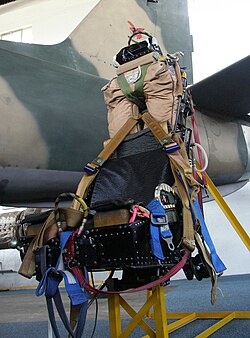
01.jpg)
Whilst downward ejection systems were being examined in USA, the Martin Baker company pioneered the use of solid propellant charges. This concept was widely adopted and Martin Baker became the world leader in integrated ejection systems.
As of December 2025, 7803 people have ejected from planes, of which Martin Baker has supplied 7700 of these seats. The survival rate is around 95%, no matter whether the initiation is at speeds from zero to supersonic and heights from zero to 80000 feet.
The systems are now fully integrated into aircraft design. They ensure arms, legs and neck are held in position with helmets designed to protect the face and provide a supply of oxygen. The integrated systems shatter or puncture the canopy, milliseconds before the pilot is violently ejected from the plane and subsequently detaching the pilot from his seat, open the parachutes and let the pilot float to earth.
We then looked at the Martin Bakers seats put into the Tornado fighter aircraft and the latest designs for the F35 aircraft, now in service with the RAF and RN.