On Monday 18 August, the Arts Appreciation group met to discover the work of the Pre-Raphaelites.
Initially known as the Pre-Raphaelite Brotherhood and later just as the Pre-Raphaelites, this group of artists were active during the mid-19th century and into the early 20th century.
But who was Raphael?
An Italian painter and the architect of the High Renaissance, Raffaello Sanzio da Urbino lived from 1483 until 1520.
He belonged to the traditional trinity of great masters of the time, the other two members being Leonardo da Vinci and Michelangelo.
On moving to Rome at the request of the Pope in 1508, Raphael became an architect. Employing over 50 apprentices and assistants in his workshop, Raphael was named as the chief architect for St. Peter's Basilica in 1514. This task was taken over by Michelangelo after Raphael's death.
Raphael was a prolific draftsman – one of the finest in the western art world - using drawings extensively to plan his compositions.
Raphael's period of greatest influence came after his death, during the late 17th to the late 19th centuries. His compositions were admired for perfect decorum* and balance, becoming the cornerstone of training at the later Academies of Art.
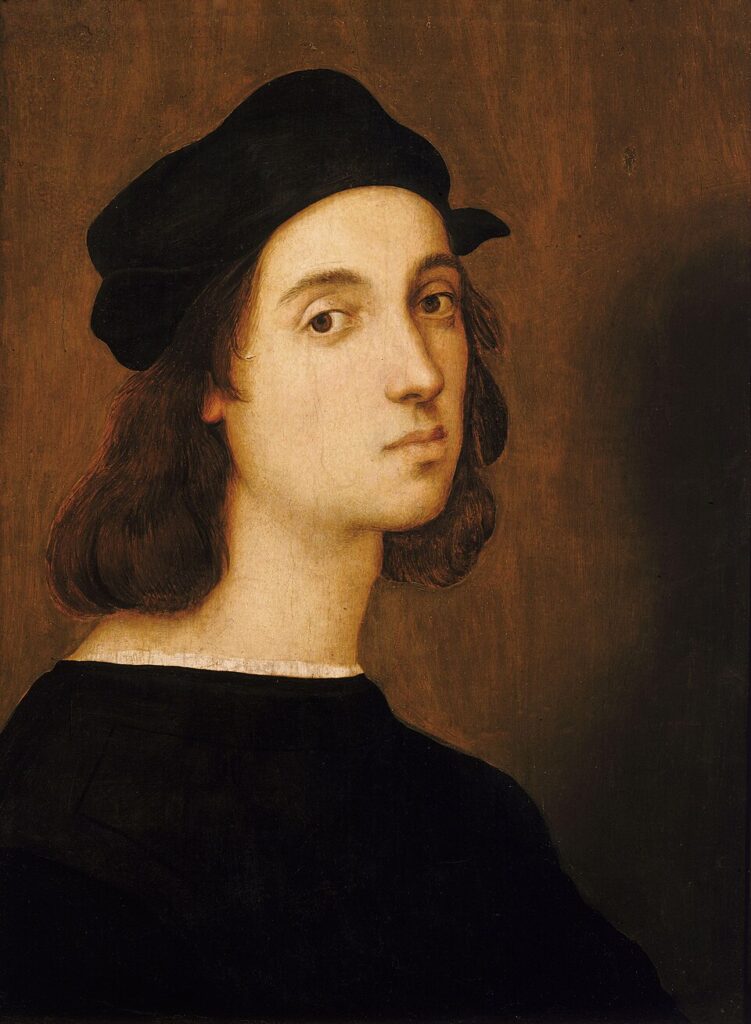
Raphael - presumed self-portrait, 1504 - 1506
Image source: Wikipedia; faithful photographic reproduction of public domain work of art

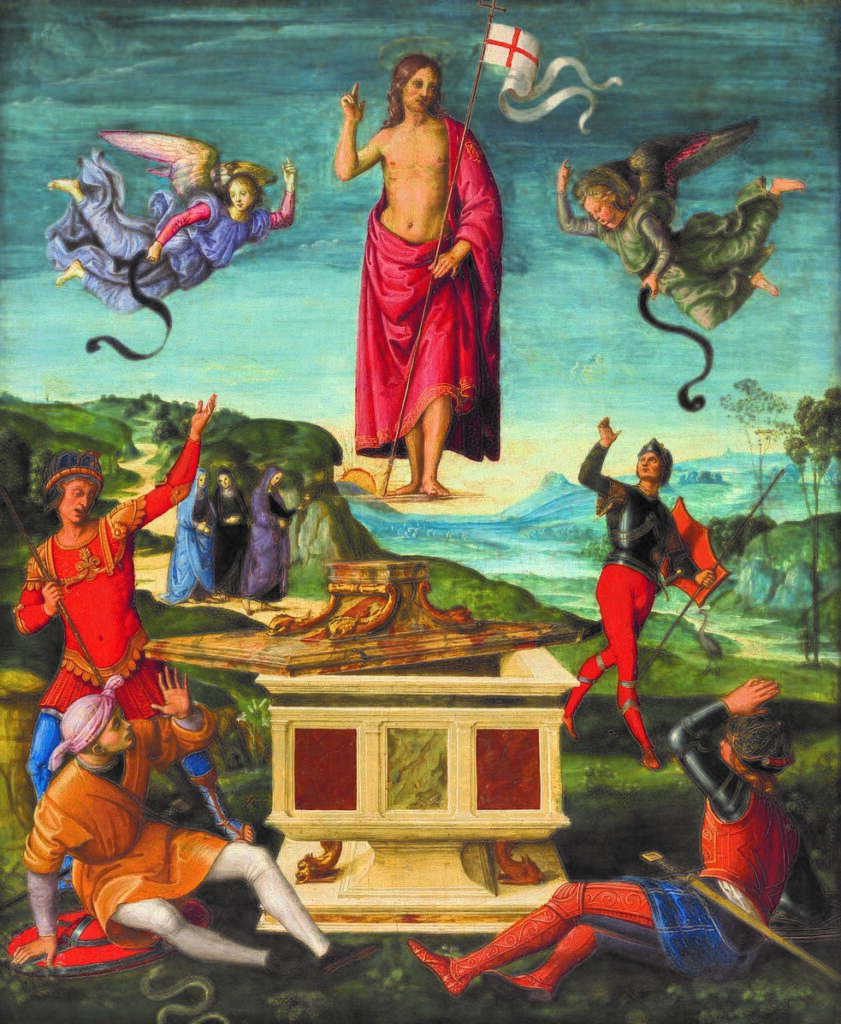
The Resurrection of Jesus Christ by Raphael, 1499 - 1502
Image source: Wikipedia; faithful photographic reproduction of public domain work of art
*According to Leonardo's theory of Decorum, the gestures which a figure makes must not only demonstrate feelings, but must be appropriate to age, rank, and position.
The Pre-Raphaelite Brotherhood, was founded in 1848...
...by Dante Gabriel Rossetti, John Everett Millais, and William Holman Hunt, the groups' numbers increasing to seven when they were joined by William Michael Rossetti, James Collinson, Frederic George Stephens, and Thomas Woolner.
The group's name reflects their desire to reject the artistic conventions dominating Western painting since the High Renaissance, particularly those associated with Raphael (1483–1520).
James Collinson came from Mansfield. He was the son of a bookseller and became known by the Brotherhood as the dormouse. He was a devout Christian – originally protestant, but subsequently converting to Catholicism and then High Anglican to facilitate his marriage to Rossetti’s sister. The exhibiting of Millais’ controversial painting, ‘Christ in the House of His Parents’, forced Collins to leave brotherhood. He believed works of this nature brought the Christian religion into disrepute.
The 'Brat Pack' of their day, their paintings were controversial. They were regarded as assaults on the eye, objectionable in terms of their realism and morally shocking.
A lot of the themes they chose to depict were quite daring such as poverty, emigration, prostitution and the double standard of sexual morality in society.
Their work had a focus on poetic symbolism particularly in their representations of biblical subjects and medieval literary themes, though many pictures were considered sacrilegious. Their pictures require a lot of concentrated reading and are so densely encoded with signs and symbols that you really have to work hard at deciphering them, for example 'The Awakening Conscience', by William Holman Hunt.
In subsequent years, many artists became associated with the Brotherhood, most of whom were the friends, family, and associates of its founding members.
Many London-based artists adopted the distinctive styles, subjects, and philosophies of what became the Pre-Raphaelite movement.
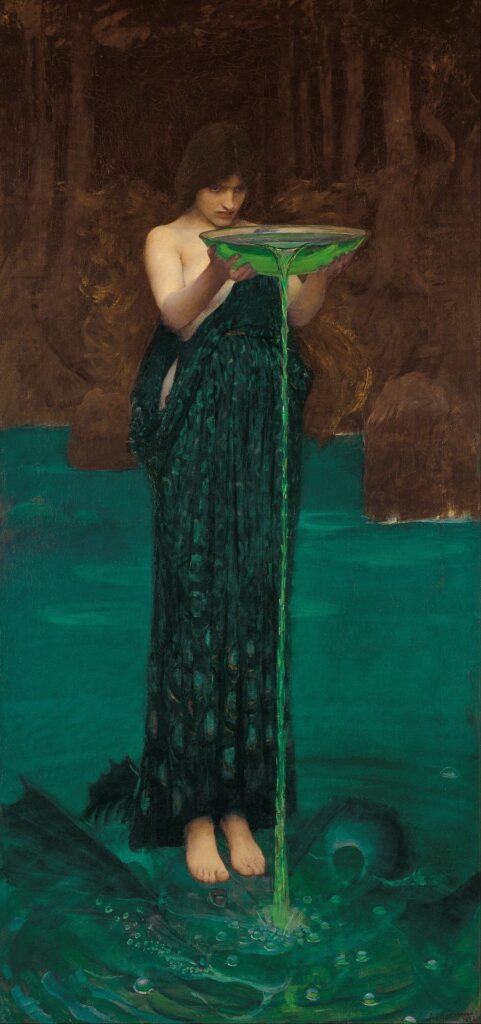
This painting is by John William Waterhouse (1849 - 1917)
Circe Invidiosa (1892), Image source: Pixabay.com
The work shows Circe pouring a green, poisonous liquid into a pool.
Inspired by classical literature, particularly Homer's Odyssey and Ovid's Metamorphoses, Waterhouse painted the mythological sorceress Circe multiple times.
Unlike their name, the Brotherhoods' lives and works were shaped, indelibly, by the women of their circle.
Through the systemic sexism of the time, these women have gone down in the history of art as muses, even though they were artists in their own right. They were painters, poets, and models.
They were often at the centre of the creations, as the protagonists of the paintings, and some of them used their roles as models to fund a career of their own as painters.
Elizabeth Siddell – started as a model to fund her painting. She was self taught which sometimes gives her figures a ‘ boneless’ appearance. She later married Rossetti and went on to become an idealised symbol of femininity.
Others in the sisterhood included Joanna Mary Boyce, Christina Rosetti, Georgiana Burne-Jones, Marie Stillman and Evelyn de Morgan.
Fanny Eaton was a British-Jamaican model who played a unique and significant role in Pre-Raphaelite art. Unlike most of the movement’s muses, who were often fair-skinned and of European descent, Fanny’s striking features and mixed-race heritage set her apart, making her one of the few Black women to be widely depicted in Victorian art.
For further information on the Pre-Raphaelite movement, please reference these videos...