This month we had 17 members attend to learn about High Voltage Direct Current (HVDC) cables used in securing our supplies of electricity.
There are frequent reports and comments about the need for more pylons to bring electricity from where it is “harvested”, i.e solar farms and offshore wind turbines, to areas of high population density. This often leads to protest groups who consider pylons unsightly and believe buried cables to be a cheaper route, but this is not necessarily the case.
Most pylons, if not all, carry high voltage alternating current, which relies on air and distance to safely insulate the system. Buried HVDC cable systems are an expensive alternative. The public often do not realise the way leave required for buried cable systems can be trenches up to 32 m wide all of which will require returning to the environmental status quo and the cables themselves are often weigh 50kg/m which means heavy machinery to install them. When you consider all the road crossings involved it is no surprise that the costs become formidable which is why pylon systems are so much cheaper.
HVDC cable systems offer several advantages. Power can be transmitted in either direction and they can be connected into AC systems without the need for synchronicity. They are also more efficient with lower losses over longer cable lengths.
Map showing HVDC links in Europe
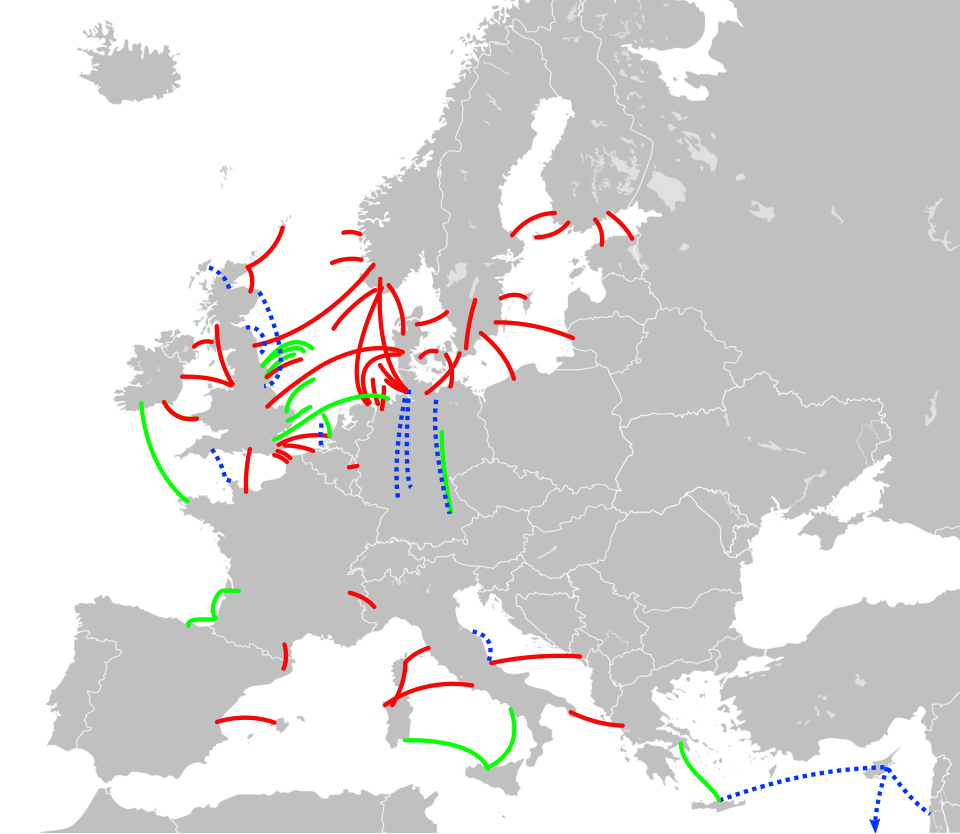
Many of these links transfer power from renewable sources such as hydro and wind
Key:
Existing links
Under construction
TBC

Over the past 120 years more long-distance HVDC cable systems have been installed in the UK, most of which have been sub-marine cables.
The Western Link runs from Hunstanton in Scotland down the Irish sea to Flint Bridge in Wales, a distance of 385 km, operating at 600 kV and the Eastern Green Link which is being installed in stages starting at Torness in Scotland to Hawthorn Pit, Durham at 196 km, with three further stages culminating in 500 km connection from Fife, to Norfolk.
The cost of these installations are several billion pounds!
We looked briefly at the number of cable systems running across the North Sea and English Channel linking up with mainland Europe. Many of you will not have realised that the UK exported a lot of power to European countries that had been reliant on Russian gas until supplies were halted.
Meanwhile plans are already in place for a 4 x 4000 km link from Morocco which will have solar and wind farms the size of London operating for 19 hours per day, delivering 3.6GW of power, equivalent to 8% of UK demand.
We can foresee a future for a trans-international HVDC grid linking the world in the same way that we now take for granted the telephonic and internet cables which link up the whole of the world.